Accelerating Business Innovation via Generative AI Development Services
Deploy production-ready Generative AI development services inside your business. Discover how semantic vector databases, custom LLM fine-tuning, and multi-agent systems eliminate hallucinations and drive real enterprise automation.


The software engineering landscape has passed the phase of simple digital transformation. Today, enterprise competitiveness is defined by cognitive transformation. The rapid evolution of Large Language Models (LLMs) and foundation transformers has shifted artificial intelligence from an analytical forecasting tool into an active, creative asset capable of generating code, synthesizing massive internal data, and driving automated customer workflows.
However, moving from an experimental chat playground to a resilient enterprise ecosystem presents significant challenges. Scaling these applications demands strict data boundaries, high-throughput pipelines, and specialized retrieval systems. At TechCirkle, we partner with global organizations to design and deploy these proprietary cognitive hubs through our comprehensive Generative AI Development Services.
Moving Beyond Out-Of-The-Box API Limitations
While using generic third-party API keys works fine for small, isolated test cases, it poses significant strategic risks for large enterprises:
- Data Sovereign Risk: Sending sensitive consumer parameters, proprietary intellectual property, or confidential financial records to external cloud networks poses compliance hazards.
- The Context Window Problem: Off-the-shelf foundation models lack an active understanding of your specific company policies, live operational logs, or structural software integrations.
- System Hallucinations: Unconstrained models frequently generate convincing but false data points, making them unsafe to put directly in front of customers or critical internal tasks.
Enterprise generative AI services solve these problems by isolating infrastructure inside secure cloud sandboxes, designing custom retrieval layers, and configuring guardrail networks to validate all incoming and outgoing data tokens.
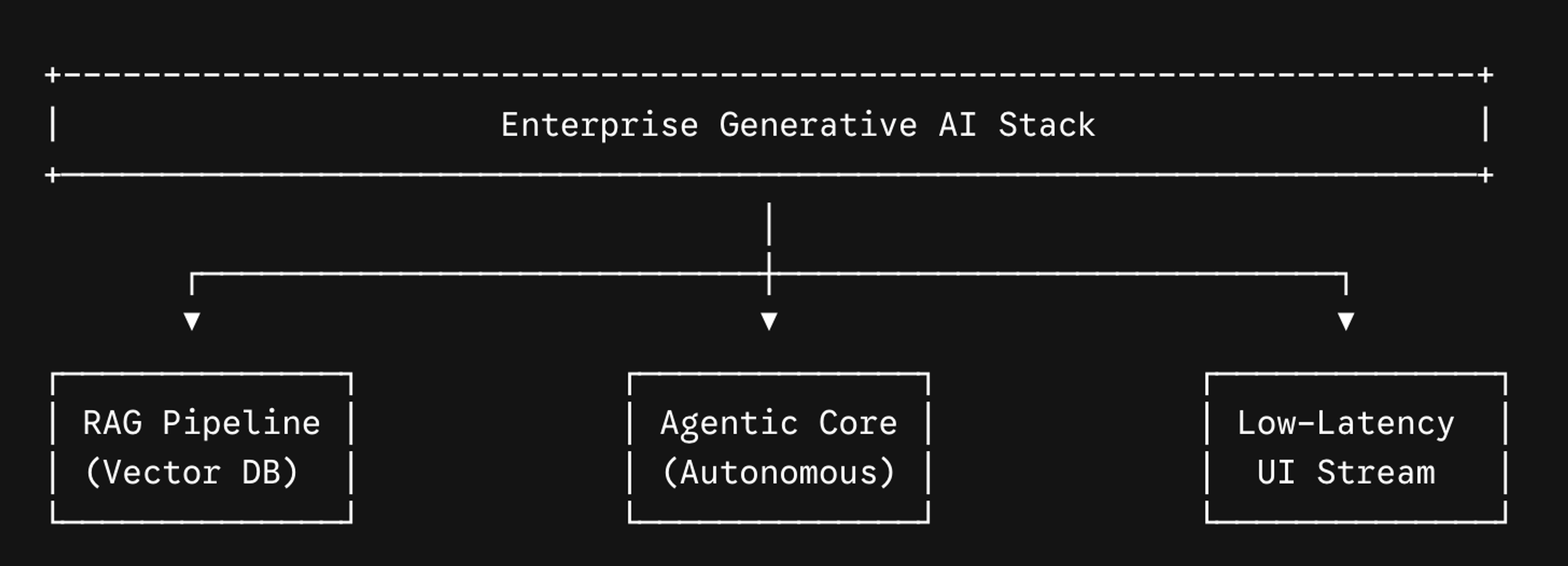
Core Architectural Pillars of Enterprise Generative AI
To build reliable applications, our software teams focus heavily on three modern architectural design patterns:
1. Retrieval-Augmented Generation (RAG)
Instead of forcing a model to memorize trillions of records through heavy compute configurations, a RAG pipeline transforms your company documents into structured vector data. At runtime, the user's input fetches relevant context from a fast semantic database, injecting this data straight into the prompt layer. This ensures the engine remains fully accurate and grounded in verified data. To learn more about implementing this approach, review our guide on What is Retrieval-Augmented Generation (RAG).
2. Multi-Agent Systems and Agentic Logic
The true breakthrough for corporate automation lies in moving past simple question-and-answer patterns toward autonomous operation. Multi-agent systems use LLMs as reasoning brains that can map out multi-step tasks, execute specialized code snippets, and review their own work before displaying it. Explore how to implement these systems through our Agentic Workflow Development solutions page.
3. Low-Latency Frontend Architecture
Streaming live AI tokens smoothly requires highly responsive web frameworks and resilient websocket connections. Choosing an optimized stack is essential to keep initial loading delays minimal. Discover our front-end approaches by visiting our AI Development Company platform.
Planning Your Initial AI Development Roadmap
When implementing generative systems, engineering teams must evaluate whether to build custom logic on top of existing applications or launch standalone web spaces.
- Scoping the Strategy: If your product team is figuring out the best rollout path, check out our resource on Custom Website vs Web App: What to Build First to structure your development goals efficiently.
- Managing Capital Efficiently: For scaling companies calculating early product engineering investments, keeping backend components lean is vital. Review our strategic breakdown on the Cost of Building a SaaS Product.
- Accelerating Release Lifecycles: To quickly launch and test an initial version, utilize our specialized engineering pipelines outlined at our MVP Development Company platform.
Partner with TechCirkle's Engineering Squads
Transitioning an advanced generative AI prototype into a secure, production-grade business system requires experienced data management, robust cloud engineering, and disciplined code design.
At TechCirkle, our software teams, cloud designers, and data leads assemble custom pipelines that protect your data privacy while unlocking massive scalability. Discover our international geographic frameworks at our AI App Development USA regional page, or connect with us directly via our Contact Us workspace to schedule an interactive system evaluation with our AI architects today.