Mobile Ecosystems for Scale: The Blueprint for Enterprise Mobile App Development
Scale industrial field productivity with enterprise mobile app development frameworks. Discover how secure on-device AI models, disconnected data synchronization, and biometric compliance shields protect corporate endpoints.


In the current corporate environment, software mobility has advanced beyond simple communication tools and mileage trackers. True enterprise mobile apps function as distributed software nodes that put operational workflows, live inventory grids, and core transaction platforms into the hands of field staff, factory managers, and executive leads. Engineering these environments demands rigorous data isolation, low-latency cross-platform compiling, and predictable cloud synchronization models.
To eliminate performance lag and secure sensitive corporate endpoints, engineering leaders must move away from generic consumer app templates. Instead, focus should center on deterministic memory management, offline-first data architectures, and automated mobile security layers. At TechCirkle, we specialize in building these mission-critical systems through our core Mobile App Development Services.
The Intelligent Client: Bringing Edge AI to Enterprise Apps
Modern corporate applications no longer rely exclusively on remote cloud processing for complex calculations. The combination of advanced hardware silicon and optimized model formats allows developers to deploy artificial intelligence directly onto mobile devices. This shift turns standard mobile interfaces into smart, context-aware operational environments.
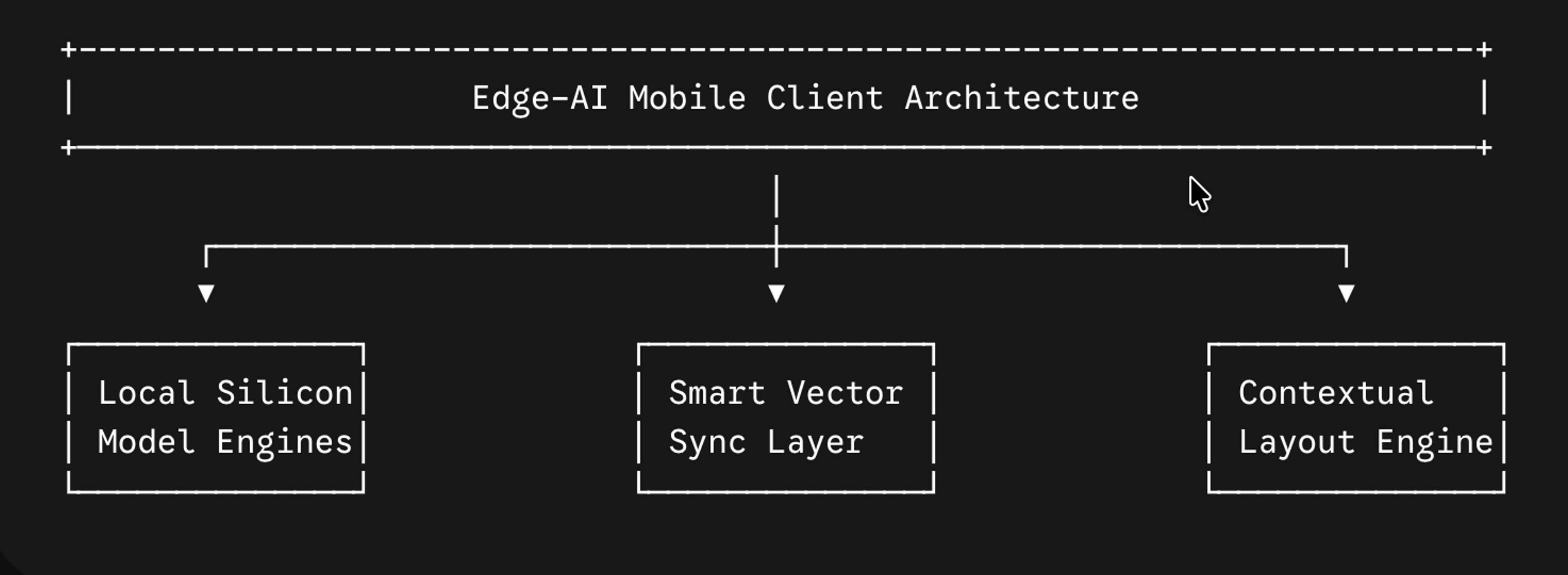
- On-Device Local Model Executions: Modern field platforms use highly optimized language and vision models to scan physical equipment assets or evaluate complex supply documents locally. This provides near-instant results even when working in remote zones without active cellular connections. To see how these automated pipelines process parameters, check out our Machine Learning Development Company portal.
- Secure, Segmented Corporate Data Syncing: Instead of sending whole documents to public clouds, mobile apps can process text fragments locally into mathematical data arrays. These arrays sync securely with central servers, keeping sensitive data safe. Learn about managing high-volume data indexing by reading our overview on What is Retrieval-Augmented Generation (RAG).
- Contextual UI Adaptation: By tracking user behavior patterns locally, mobile interfaces can reorganize shortcuts and input fields automatically based on active workflows, maximizing employee efficiency.
Critical Structural Pillars of Enterprise Mobility
To deliver reliable performance under high enterprise workloads, mobile engineering strategies focus on three primary pillars:
1. Offline-First Synchronization Architectures
Enterprise mobile applications frequently run in low-connectivity areas like subterranean facilities or remote fields. Building these systems requires robust local databases (such as SQLite or Realm) paired with background workers that handle synchronization automatically, resolving data conflicts smoothly once connectivity is restored. Discover how we connect web dashboards to these distributed systems on our Web Application Development Company workspace.
2. Unified Cross-Platform Codebases
Maintaining independent code repositories for iOS and Android often leads to mismatched feature behaviors and higher maintenance overhead. Adopting optimized cross-platform compilation frameworks enables development teams to deploy unified feature sets simultaneously from a single codebase. Review our in-depth framework comparison on React Native vs Flutter 2026 to find the right strategy for your internal staff roadmap.
3. Hardened Endpoint Governance and Enterprise MDM
Mobile applications connected to corporate infrastructure represent an entry point for potential security threats. Hardening these platforms involves implementing strict biometric access parameters, forcing automatic memory clearing when apps background, and ensuring full compatibility with Mobile Device Management (MDM) software for remote data wiping.
Balancing Mobility Lifecycles with Modern AI Engineering
Deploying an enterprise-grade mobile application requires matching advanced technical features with clear launch timelines and capital efficiency.
- Optimizing Corporate Workflows: If your strategic goal is to launch autonomous multi-agent operational tools to handle background data updates, view our capabilities at our Agentic Workflow Development solutions workspace.
- Structuring Initial Project Budgets: Learn about managing early software engineering investments and infrastructure footprints efficiently by exploring our guide on the Cost of Building a SaaS Product.
- Accelerating Phase-One Rollouts: To test new internal operational workflows with a target user group quickly before committing to a massive roll-out, review our strategies at our MVP Development Company hub.
Partner with TechCirkle for Next-Generation Mobility Systems
Building secure, high-performance, and AI-enabled mobile applications for the enterprise environment requires deep system knowledge, tight data security practices, and reliable cloud integration.
At TechCirkle, our global software developers, mobile engineers, and systems architects deliver robust corporate mobility platforms designed to adapt as your organization grows. Explore our comprehensive capabilities through our corporate About Us platform, or reach out directly via our Contact Us portal to schedule a complete system review and mobile architecture consultation with our principal engineers today.